/blog
A UTM naming convention your team will actually follow
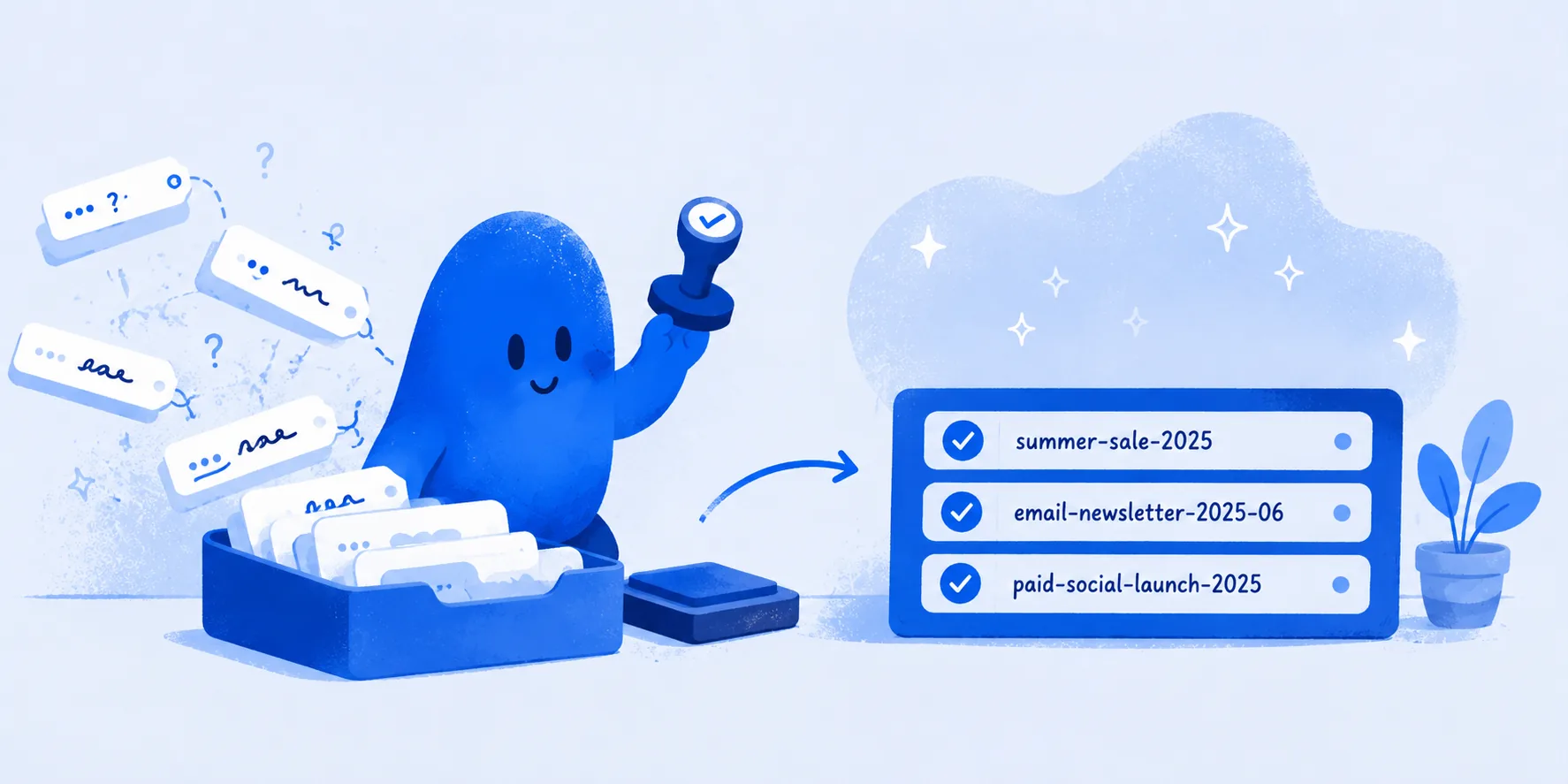

Open a campaign report that nobody agreed a convention for and you will find facebook, Facebook, FB, and fb_ads sitting in four separate rows. Between them they sent a third of your traffic, and the report shows four unremarkable channels instead of one good one.
No analytics tool prevents this. UTM values are free text. Whatever someone typed at 5pm on a Friday is what you compare against next quarter.
The fix is a written convention, short enough that nobody has to look it up twice.
The rules
Lowercase, always. Most analytics tools treat Email and email as different values. Lowercase is the one rule that costs nothing and prevents the most damage.
Hyphens between words, never spaces. A space becomes %20 in the URL and looks broken when it appears in a report. spring-sale reads fine anywhere.
Fix the vocabulary for source and medium. You group your reports by these two, so they need a closed list. Campaign names can stay looser. You invent a new one every few weeks anyway.
Date the campaign, don't describe it twice. 2026-08-launch sorts chronologically and stays unambiguous a year later. launch does not, and you will have three of them.
Never tag internal links. A UTM between two of your own pages restarts the session and takes credit away from whoever actually sent the visitor.
A vocabulary to start from
Medium describes the kind of channel, and the list should stay short:
| Medium | Use it for |
|---|---|
email |
Newsletters, lifecycle emails, one-off sends |
social |
Unpaid posts on any social platform |
cpc |
Paid search and paid social |
referral |
Partner sites, directories, sponsorships |
qr |
Anything printed or scanned in the physical world |
affiliate |
Partners paid on performance |
Source names the specific place the click came from: linkedin, mailchimp, producthunt, acme-blog. When someone asks for a new medium, what they usually want is a new source.
What it looks like in practice
The August product launch newsletter:
utm_source=newsletter&utm_medium=email&utm_campaign=2026-08-launch
A paid LinkedIn ad in the same campaign, with two creatives being tested:
utm_source=linkedin&utm_medium=cpc&utm_campaign=2026-08-launch&utm_content=video-a
A partner including you in their weekly roundup:
utm_source=acme-blog&utm_medium=referral&utm_campaign=2026-08-launch
Same campaign in all three, so the report rolls them up. Different source and medium, so you can still see which one carried it.
Our free UTM builder will assemble any of these for you and show the finished URL as you type.
Write it down where people already are
A convention nobody can find is a convention nobody follows. Put the vocabulary in whatever document your team already opens before publishing, next to the copy checklist. One page is enough: the two tables above and three examples.
Then cut down how often anyone has to type it. In GoGoLink the UTM values are fields on the link rather than text pasted into a URL. Whoever creates the link sets the spelling once, and it holds everywhere that link is shared.
The useful side effect is that the tags are attached at redirect time rather than stored in the destination. A campaign name misspelled on a link that is already printed on a conference banner can still be corrected. If you are still deciding which parameters to use at all, start here.